Skateboard Jump Line Art: A Designer’s Embroidery Review
I knew the moment I opened the Skateboard Jump Line Art file that it would end up on a sweatshirt. Not a plain, forgettable one—the kind a teenager grabs off a craft fair table and won’t take off for a week. This continuous line art sketch of a skater mid-ollie has exactly the kind of motion, attitude, and urban energy that makes a handmade product feel like a boutique find, not a craft project.
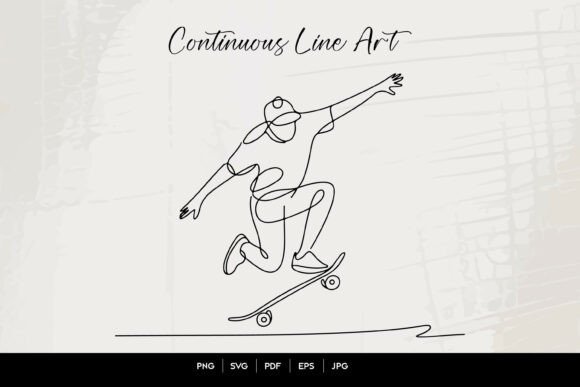
Before I even thought about hooping fabric, I studied the design’s personality. The single flowing line creates a silhouette of a skateboarder in full jump, board tilted, arms out for balance, almost like a freehand drawing that captured a split-second trick. It’s labeled as continuous, lineart, skateboard, skateboarding, skater, extreme, sport, action, jump, ollie, trick, street, urban, youth, energy, motion, balance, freestyle—and that’s exactly what you see. There’s no clutter, no heavy shading, just a confident, minimalist stroke that reads clearly even from a distance. That’s gold for embroidery, where too much detail turns into a muddy mess on fabric.
The product is a Graphics asset in the Crafts category, delivered in five file formats: PNG, SVG, EPS, PDF, and JPG. This is important because it’s not an embroidery file. You’re getting a versatile design that you or a digitizer must convert to a machine-readable format. The vector files (SVG, EPS) are a huge advantage here—they let you scale the artwork up or down without losing the crisp line quality, which is essential before you even touch digitizing software.
First Impressions and the Mood It Creates
What struck me first was the sense of instant motion. The way the skater’s body arcs over the board, with a tiny suggestion of spinning wheels and a trailing motion line, feels like a freeze-frame of a street session. It’s defiantly youthful, a little raw, and full of that freestyle spirit. In a world of overly polished embroidery designs, this one breathes. It’s the kind of graphic that works because it doesn’t try too hard—it just captures a moment.
For a craft business, that mood translates directly into product appeal. Imagine this on a canvas tote bag, a back patch on a denim jacket, or a simple unisex tee. It reads as authentic, not corporate. The line art style also means it won’t dominate a piece; it can sit quietly on a pocket corner or become the focal point on a large hoop project. The urban vibe and youth energy make it a natural fit for anyone selling to the skate, streetwear, or casual lifestyle crowd.
Real Product Testing: How the Design Behaves on Fabric
I decided to put the Skateboard Jump Line Art to work on a medium-weight organic cotton sweatshirt—the kind of blank I’d use for a client’s personalized gift. I digitized the design using a single-pass running stitch, mimicking the hand-drawn look. On a 5x7 hoop, I scaled it to about 4.5 inches wide, enough to keep the ollie detail and the board’s curve intact without making the line too thin.
Right away, I noticed how the continuous line concept forced me to think about stitch path. The design has almost no breaks, which means the needle traces the skater’s outline, the board, and the motion arcs in one fluid journey. That’s great for a clean stitch-out, but it also means you need to be careful with jump stitches and trim points. I used a no-show mesh stabilizer and a light topping on the fleece interior to prevent the stitches from sinking. The result was a fine, dark graphite-grey thread on a heather grey sweatshirt—subtle, but with enough contrast to hold its own.
When I tested the same design on a black tote bag with white thread, the balance of the composition really shone. The negative space inside the skater’s body and between the board and the ground made the silhouette pop. It’s a reminder that with line art, motion and energy come from what’s left out, not just what’s stitched. On a cap, however, I had to be more cautious. The curved surface distorted the design slightly, so I opted for a smaller 3-inch version on the front panel, and I reinforced the stabilizer with a sheet of adhesive backing to keep the shape crisp.
Where This Design Shines in a Craft Business
If you’re selling on Etsy or at a maker’s market, the Skateboard Jump Line Art gives you a versatile asset that works across many products. Here are a few that I’d confidently list after testing:
- Crewnecks and hoodies – The line art feels modern and graphic, ideal for a minimalist streetwear drop.
- Canvas tote bags – The design scales beautifully for a large side panel, and the continuous line makes it look like an artist’s signature.
- Unstructured baseball caps – A smaller placement on the front or side adds a cool, low-key detail.
- Embroidered patches – Digitize with a wider satin stitch border and you have a sew-on patch that teenagers love.
- Pillow covers – A large, centered placement turns a basic cushion into a gift for a skater’s bedroom.
- Kitchen aprons – Surprisingly, the urban edge works on a denim apron, blending function with personality.
For digital product sellers, the included JPG and PNG files are a bonus. You can create realistic printable mockups for your shop listings, showing the design on apparel without stitching a single thread. This helps customers visualize the final product and builds trust before they buy. The vector files (SVG, EPS) also let you resize the graphic for screen printing, sublimation, or even vinyl cutting, so the design asset keeps giving beyond embroidery.
Watch Out for These Fabric and Placement Pitfalls
No design is perfect for every surface, and the Skateboard Jump Line Art has a few natural limitations. I learned these the hard way on some test scraps:
- Stretchy, thin fabrics – The continuous line can pucker on lightweight jersey or lycra. Use a heavyweight cutaway stabilizer and consider a slightly denser stitch to hold the shape.
- Heavily textured materials – Terry cloth, fleece with a deep pile, or boucle can interrupt the visual flow of the line. Stick to smooth, stable bases.
- Very small hoop sizes – Attempting to squeeze this into a 4x4 hoop may force you to shrink the design below 3 inches, at which point the ollie detail and board wheels become a blur. Test first.
- Dark fabrics with dark thread – The line art relies on contrast. If you stitch black on navy, the design disappears. Always check your thread choice against the actual fabric.
- Products that face heavy washing – A delicate running stitch on a tea towel or a baby bib won’t hold up to frequent laundering unless you secure it with a dense underlay and proper finishing.
- Curved surfaces – Caps and small bags need careful hooping and possibly a design adjustment to avoid warping the jump trajectory.
Before committing to a final product, I always run a test on a similar fabric. In this case, I also converted the design to a black-and-white silhouette mockup to see if the shape still read as a skateboarder. It did—the trick and the ollie stance are unmistakable. That’s a good sign that even if thread colors shift, the visual story remains intact.
The Nitty-Gritty: Digitizing and Stitch Decisions
Because the Skateboard Jump Line Art is a graphic, not a ready-to-stitch file, digitizing becomes your creative tool. The single continuous line invites you to choose between a sketchy running stitch, a bold satin stitch, or a mixed approach. I personally prefer a 2-ply running stitch for that hand-drawn look, but for a more commercial product like a patch, a 2mm satin stitch gives the design weight and durability.
One thing to watch: the motion lines around the wheels and board are quite fine. In the original vector, they’re elegant, but when you shrink the design for a cap, those lines can become sewing-machine hazards. I sometimes simplify the tiniest details, merging a few strokes into a single arc, while keeping the extreme sport feel. The balance of the skater’s body is what sells the design, so as long as the silhouette and the board angle remain, you can edit fearlessly.
Another tip: print the design at actual size and pin it to the fabric. Step back. Does the motion still read? Is the board clearly defined? This step saves you from wasting time on a digitized file that looks great on screen but fails on material.
Licensing and Commercial Use: What You Need to Verify
The product description tells you what you get—PNG, SVG, EPS, PDF, JPG—but it doesn’t spell out the license terms. Before you stitch this design onto a product you intend to sell, check the original listing for any commercial use restrictions. Many graphics assets in the Crafts category come with a personal-use-only license by default, and you may need to purchase an extended license to offer finished items or digital embroidery files. As a small business owner, I never assume; I look for the license details and keep a record. This protects your shop and respects the artist’s work.
Final Thoughts from a Professional Embroidery Designer
The Skateboard Jump Line Art is one of those rare finds that feels like it was made for embroidery even though it wasn’t. Its continuous line aesthetic, urban attitude, and crisp silhouette make it a standout for personalized apparel, accessories, and handmade gifts. The fact that it’s delivered as a vector-based graphic means you control the digitizing, scaling, and final look down to the last stitch.
For a craft business, it’s a smart addition to your design library. It speaks to a clear audience—skaters, streetwear fans, youth culture—and it works on enough product types to justify the time you’ll invest in testing and digitizing. I’ve already used it on a sample tote and a pullover, and both got immediate positive reactions. The energy and motion are contagious, and in a market flooded with generic flowers and monograms, that counts for a lot.
Just remember: test on scrap fabric, dial in your stabilizer, simplify when the scale demands it, and always check your license. If you do that, the Skateboard Jump Line Art might just become the signature piece in your next craft fair collection.